Electrically conductive overlayer coatings are needed in many applications ranging from damage prevention from unintentionally accumulated charges to the prevention of cross-talk in dense conductor systems. Electrospell’s Polypolaron is a versatile conductive polymer coating that can be easily applied and removed. It can be used to make objects and surfaces electrically conductive with the value of conductivity controlled through film thickness.
Features and Applications: eatures and Applications
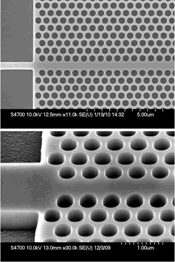
Charge dissipation coating for electron microscopy observations
Transparent in visible light, enabling underlying samples to be observed
Transparent to incident electron beam but highly conductive for accumulated charge, eliminating charging-induced image distortion during electron microscopy observations
Extremely well-suited for high resolution electron beam lithography applications – efficient, instantaneous charge dissipation prevents beam distortion, maintaining patterning fidelity for feature sizes both above and below 100 nm
Quick spray-on coating for producing a moderately conducting surface on almost any substrate – Instant ESD and EMI protection
Can be added to other materials such as adhesives, paints and lacquers for making them electrically conducting
Thin film conductor for applications in organic electronics such as conducting tracks and electrodes for thin-film transistors
Anode layer coating for OLEDs on glass and plastic substrates
Use on flexible electronic substrates as contacts and printed tracks

Polypolaron is based on electrically conducting conjugated polymers. It is a blend of polythiophenes and polyanilines in an aqueous dispersion with added stabilising agents. This effective formulation produces electrically conducting polymer films with smooth morphology when coated using spray, roller or spin coating techniques. Films as thin as 50 nm are free from pin holes and exhibit considerable electrical conductivity. Typical conductive films are formed at thicknesses in the range of 100 nm to 500 nm. Depending on thickness, Polypolaron films have a light or dark greyish tint. All metals form good electrical contacts with Polypolaron films but especially low contact resistances are achieved with gold and copper. Silver paint and graphite also make very good electrical contacts with Polypolaron films. The removal of a Polypolaron coating is particularly easy as it can simply be washed away with water or one of several organic solvents such as dimethyl sulphoxide, ethanol or acetone. It can also be removed with oxygen-containing dry etch processes such as oxygen plasma ashing. Being a polymeric material Polypolaron cannot withstand high temperatures and its use at temperatures in excess of 80 °C is not recommended.
For further information on Polypolaron please click here.
For Polypolaron Material Safety Data Sheet please click here.
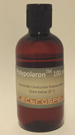
Polypolaron is available in 25 ml and 100 ml plastic
containers for immediate delivery worldwide.
Please contact Electrospell for price and delivery information.